Now available in Kenya

Slow Sodium
Tablets Kenya

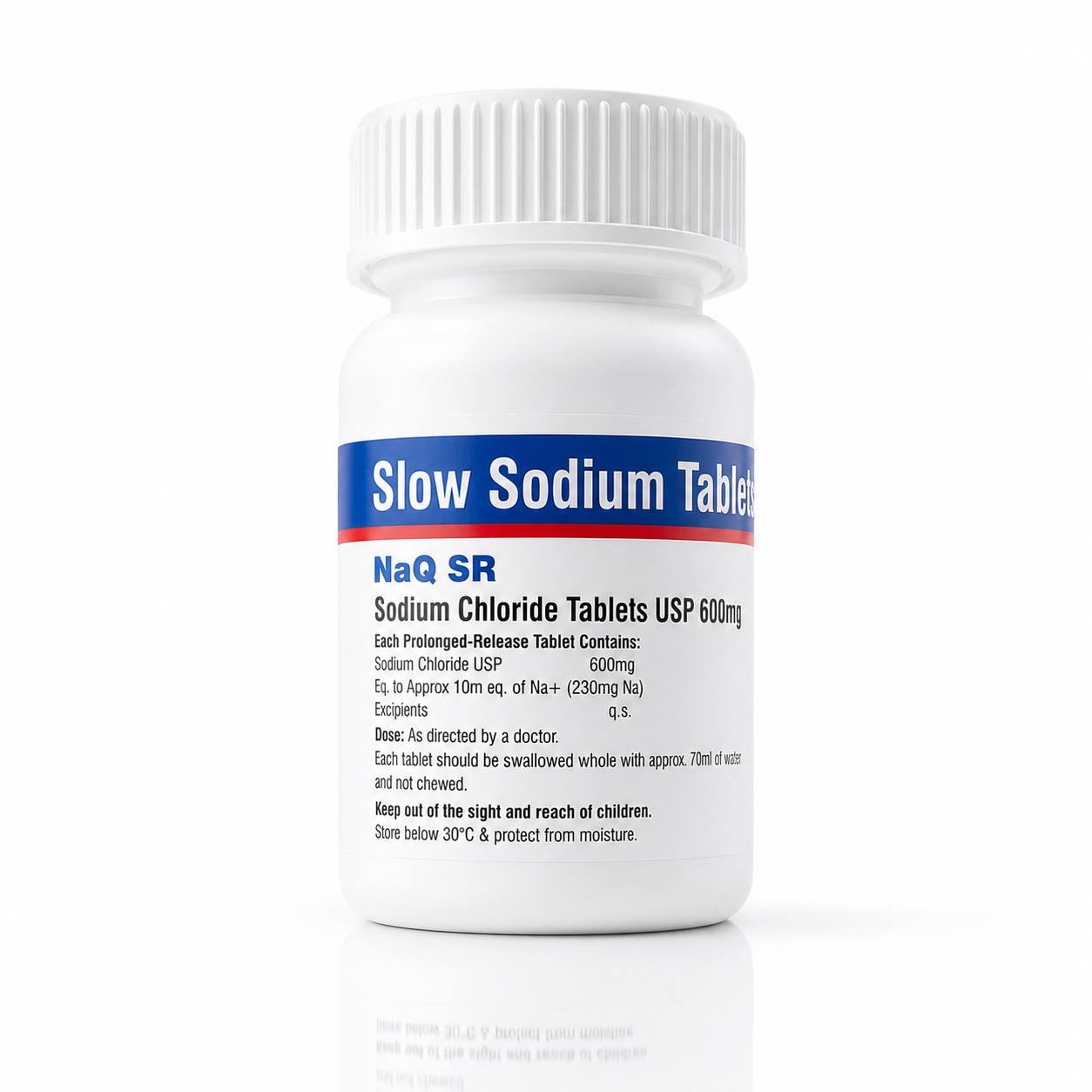
NaQ SR · Prolonged-Release Sodium Chloride 600mg

A prolonged-release sodium chloride formulation. This page provides general educational information about hyponatraemia and prolonged-release sodium chloride. It is not medical advice — please refer any clinical decisions to a qualified healthcare professional.

NaQ SR Slow Sodium Tablets — Sodium Chloride USP 600mg prolonged-release bottle, available in Kenya

For Healthcare Professionals

NaQ SR is a prolonged-release sodium chloride formulation. The clinical contexts in which slow sodium is generally used include those below. Full product information is available to professionals on request.

  • Hyponatraemia (sodium chloride deficiency)
  • Excessive salt loss conditions
  • Electrolyte balance in chronic disease
  • Muscle cramps during haemodialysis
  • Oral sodium replacement
Request Product Information

For Patients & Caregivers

Slow sodium tablets should only be used if prescribed by your doctor following a diagnosis. Never self-medicate. If you have been prescribed treatment, the points below are general reminders — always follow your own doctor's instructions.

  • Follow your doctor's prescribed dose
  • Store below 30°C in original container
  • Keep out of sight and reach of children
Make an Enquiry →

Hyponatraemia in Kenya:
What Clinicians Need to Know

Low blood sodium is one of the most common electrolyte disorders encountered in clinical practice — and one of the most frequently missed. Recognising it early changes outcomes.

Hyponatraemia is a condition in which blood sodium falls below 135 mmol/L. It is the most common electrolyte disorder in hospitalised patients, affecting 15–30% of admissions. Signs can range from subtle fatigue and cognitive changes to more serious presentations in severe cases. Diagnosis and management should always be guided by a qualified healthcare professional.

Chronic mild hyponatraemia — once considered benign — is now strongly associated with cognitive impairment, increased fracture risk, gait instability, and higher all-cause mortality. Many cases present under the guise of depression, dementia, or simple deconditioning, particularly in elderly patients.

15–30%
of hospitalised patients present with some degree of hyponatraemia
Source: Upadhyay A, et al. Am J Med. 2006; Hoorn EJ, Zietse R. JASN. 2017
increased fall and fracture risk in older patients with untreated low sodium
Source: Renneboog B, et al. Am J Med. 2006
High-Risk Patient Groups
Elderly patients Diuretic users Heart failure Liver cirrhosis Chronic kidney disease SIADH Post-operative Heavy exertion / sweating Haemodialysis patients
These could be some of the possible presentations

Cognitive Changes

Confusion, poor concentration, memory lapses — often attributed to age or dementia

Fatigue & Lethargy

Persistent tiredness disproportionate to activity or sleep quality

Nausea

Nausea, vomiting, reduced appetite without identifiable cause

Muscle Weakness

Cramps, spasms, proximal muscle weakness and myalgia

Gait Instability

Unsteady walking and increased falls — even at mild serum deficit

Severe Presentation

Seizures, respiratory arrest in acute severe hyponatraemia (<120 mmol/L)

Why Prolonged Release
Matters

In general, an immediate-release formulation releases its active ingredient quickly, while a prolonged-release formulation is designed to release it gradually over a longer period. The following explains how prolonged-release formulations work — as general education, not medical advice.

Illustrative: How Prolonged Release Works
Sodium level Time
Prolonged release — steady Rapid release — spikes

Illustration only. This diagram explains, in general terms, how a prolonged-release formulation is designed to release its active ingredient gradually compared with a rapid-release one. It is general educational information and not a measured product claim.

  • Gradual, Prolonged Release
    A prolonged-release matrix is designed to release its active ingredient gradually rather than all at once, so levels are intended to rise and fall more gently over time.
  • Designed for Tolerability
    By avoiding a single rapid release, prolonged-release formulations are generally designed to be gentler on the stomach than immediate-release alternatives.
  • Manufactured in a GMP-Approved Facility
    Produced in a facility operating to Good Manufacturing Practice (GMP) standards, with quality processes applied across production.
  • Simple to Take
    A film-coated tablet — no dissolving and no unpleasant taste. Always take exactly as directed by your prescriber.

The Essentials

A brief summary only. This is not a full prescribing document and not medical advice. A representative can share complete product information on request.

What It Is

  • NaQ SR — Slow Sodium Tablets
  • Sodium Chloride 600mg, prolonged-release
  • Film-coated tablet · 100 per jar

Dosage

  • Always follow your prescriber's instructions.

Frequently Asked
Questions

General questions about hyponatraemia (low blood sodium) and prolonged-release sodium chloride. This is health awareness information only and is not a substitute for advice from a qualified healthcare professional.

For anything not answered here, please use the enquiry form below.

Hyponatraemia is a condition where the level of sodium in the blood falls below 135 mmol/L. It is one of the most common electrolyte disorders, affecting 15–30% of hospitalised patients. Possible signs can include fatigue, confusion, muscle cramps and nausea. Diagnosis and management should always be carried out by a qualified healthcare professional.
Slow sodium (prolonged-release sodium chloride) preparations are generally used, on the advice of a healthcare professional, in connection with sodium chloride deficiency, excessive salt loss and electrolyte balance support. A prolonged-release formulation is designed to release sodium gradually rather than all at once. Always consult a doctor.
Yes! To find out more, please fill in the enquiry form below and a representative will get back to you.
In general, immediate-release salt preparations release sodium quickly, producing a rapid rise and fall in levels, whereas a prolonged-release formulation is designed to release sodium gradually over a longer period. This is general educational information about how prolonged-release formulations work and is not medical advice.

Make an Enquiry

For more information or any questions, reach out using the details below or send a message through the form.

Send us a message and a representative will get back to you.

Send an Enquiry
We respond within one business day. WhatsApp responses are typically faster.

Important — Please Read

Do not take this or any medicine unless it has been prescribed by your doctor following a proper diagnosis. This product is not intended for self-treatment. Please consult a qualified healthcare professional before taking this health product.

This website is provided for general health awareness and educational purposes only. The information here is not medical advice, is not a substitute for consultation with a qualified healthcare professional, and should not be used to diagnose or treat any condition. If symptoms persist, seek medical advice.

slowsodium.co.ke
naqsr.co.ke